Becoming Part of the Community Buying a home isn’t just about moving into a new…
Do You Need 20% Down to Buy a House? The 20% Down Myth
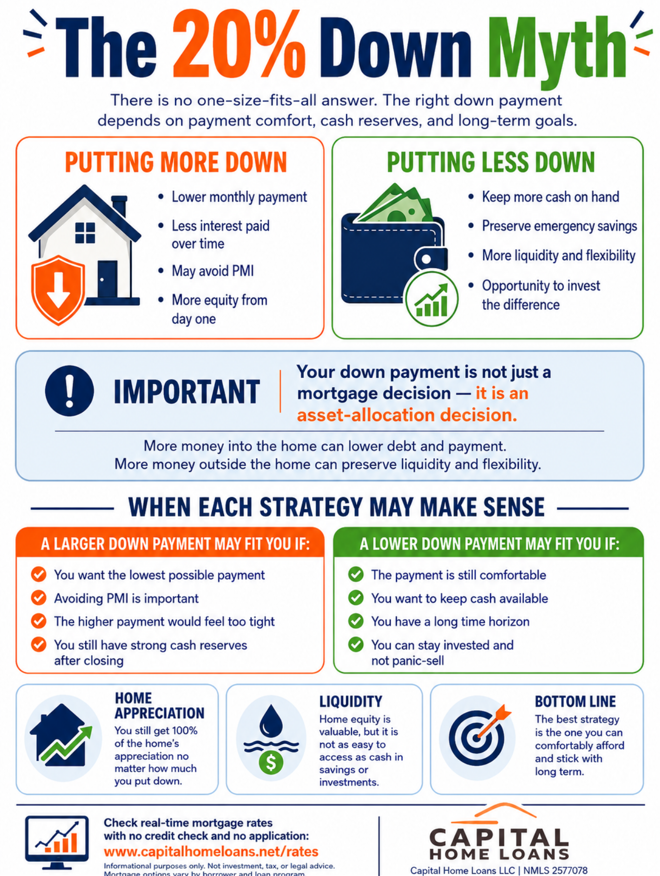
One of the most common homebuying myths is that you need a 20% down payment to buy a house. In reality, many buyers purchase homes with far less than 20% down, and some eligible borrowers may qualify for mortgage programs that require no down payment at all. The amount you actually need depends on the loan program, property, credit profile, income, and other qualification factors.
Why Do So Many Buyers Think 20% Is Required?
Twenty percent became a common benchmark because putting 20% down on a conventional mortgage can help borrowers avoid private mortgage insurance (PMI) and reduce the amount they need to borrow. But avoiding PMI is not the same as meeting a universal down payment requirement. Many loan programs allow qualified buyers to purchase with much less than 20% down.
How Much Down Do You Need to Buy a House?
The minimum down payment can vary significantly by mortgage program and borrower qualifications. Common examples include:
- Conventional loans: Some programs may allow eligible buyers to purchase with as little as 3% down.
- FHA loans: Eligible borrowers may be able to purchase with as little as 3.5% down.
- VA loans: Eligible veterans, active-duty service members, and certain surviving spouses may qualify with no required down payment.
- USDA loans: Eligible borrowers purchasing qualifying properties in USDA-eligible areas may qualify with no down payment.
- Down payment assistance programs: Some buyers may qualify for grants, forgivable loans, or other assistance that can reduce the amount of cash needed upfront.
- If you want a deeper comparison of conventional, FHA, VA, USDA, and down payment assistance options, see our guide on how much you may need for a down payment on a house.
Is Putting 20% Down Still a Good Idea?
Sometimes—but not always. A larger down payment can reduce the amount you borrow, lower the monthly principal and interest payment, and may eliminate private mortgage insurance on certain conventional loans.
The better question is not “Can I put 20% down?” but “How much should I put down based on my overall financial situation?”
What About PMI?
Private mortgage insurance (PMI) is commonly required on conventional loans when the down payment is below 20%. PMI protects the lender, not the borrower, and the cost can vary based on factors such as credit score, loan amount, and loan-to-value ratio.
Paying PMI is not automatically a bad thing. For some buyers, accepting PMI can make it possible to purchase sooner instead of waiting years to save a full 20% down payment.
Should You Wait Until You Have 20% Saved?
Not necessarily. Waiting to save a full 20% down payment may make sense for some buyers, but for others it can delay homeownership unnecessarily. Home prices, interest rates, rent, income, and personal savings goals can all change while you wait.
Instead of focusing on one percentage, compare the available loan programs, estimated monthly payment, cash needed at closing, and how much money you would still have in reserves after the purchase.
Do You Need 20% Down to Buy a House? The Bottom Line
A 20% down payment can be a strong option, but it is not a universal requirement for buying a home. Depending on the mortgage program and your qualifications, you may be able to purchase with a much smaller down payment—or potentially no down payment at all.
Capital Home Loans can help compare conventional, FHA, VA, USDA, and available down payment assistance options so you can see what may fit your situation.

Related Posts